
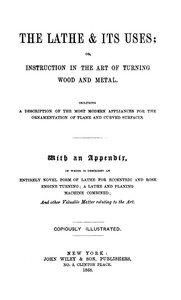
The Lathe & Its Uses by James Lukin
Let's get this out of the way: this is not a novel. If you're looking for a thrilling plot with heroes and villains, you won't find it here. What you will find is something quietly remarkable.
The Story
There's no traditional story. Instead, James Lukin, a skilled artisan and writer from the 1800s, guides you through the entire world of the lathe. He starts with the basics—what a lathe is, the different types (from simple foot-powered ones to early engine lathes), and what each part does. Then, he gets into the good stuff: how to use it. He walks you through choosing the right wood or metal, how to secure it, and the purpose of dozens of specialized chisels and tools. The 'narrative' is the journey from a raw material to a finished object—a table leg, a bowl, a metal spindle. He explains the techniques, the common mistakes, and the little tricks of the trade that separate a rough job from a clean, precise one.
Why You Should Read It
I picked this up out of sheer curiosity and couldn't put it down. Lukin's voice is the star here. He writes with a calm, confident authority that never talks down to you. You can feel his deep respect for the craft and his genuine desire to teach. Reading his instructions is like listening to a supremely knowledgeable friend. Beyond the practical advice, the book is a window into a different mindset. In our age of instant everything, Lukin celebrates patience, careful observation, and the deep satisfaction of mastering a physical skill. He reminds you that creation is often a slow, thoughtful conversation between the maker and the material. It made me look at every old wooden banister and vintage metal fitting with new, appreciative eyes.
Final Verdict
This book is a hidden gem for a specific but broad audience. It's perfect for history buffs who want to understand the hands-on reality of the Industrial Revolution. It's a must for modern woodworkers or metalworkers interested in the roots of their craft. Most surprisingly, it's great for anyone who enjoys well-written, clear nonfiction about how things work. If you like the vibe of watching a master restorer at work or reading a fascinating old diary, you'll find a strange comfort in Lukin's pages. Just don't expect a murder mystery—the only thing being carved up here is a piece of beechwood.






Ava Martin
1 year agoAs someone who reads a lot, it manages to explain difficult concepts in plain English. Highly recommended.